
Do your ears control balance? Yes. A fluid-filled structure no bigger than a five-cent coin, buried deep inside your inner ear, is what tells your brain whether you are standing, spinning, falling, or still.
That structure is the vestibular system. When it works, balance feels effortless. When it fails, the rest of your body has nothing to correct against, and ordinary movement can feel like standing on a moving boat.
Most people blame dizziness on their feet, their blood pressure, or their age. The inner ear is the more likely culprit, and one of the most treatable, especially when hearing loss is part of the picture.
What Is the Vestibular System?
The vestibular system is the sensory network in your inner ear that controls balance, spatial orientation and head-eye coordination. It sits inside the labyrinth, a maze-like structure carved into the temporal bone on each side of your skull.
The system runs continuously. It sends signals to your brainstem and cerebellum 24 hours a day, even when you are not consciously thinking about balance.
Balance is not a single sense. Your brain combines vestibular input with vision and proprioception (the body’s awareness of its own position) to produce a stable sense of where you are in space.
When the system is healthy, balance feels effortless. When it is damaged, ordinary movement can feel like standing on a moving boat.
The Inner Ear’s 3-Sensor Balance System
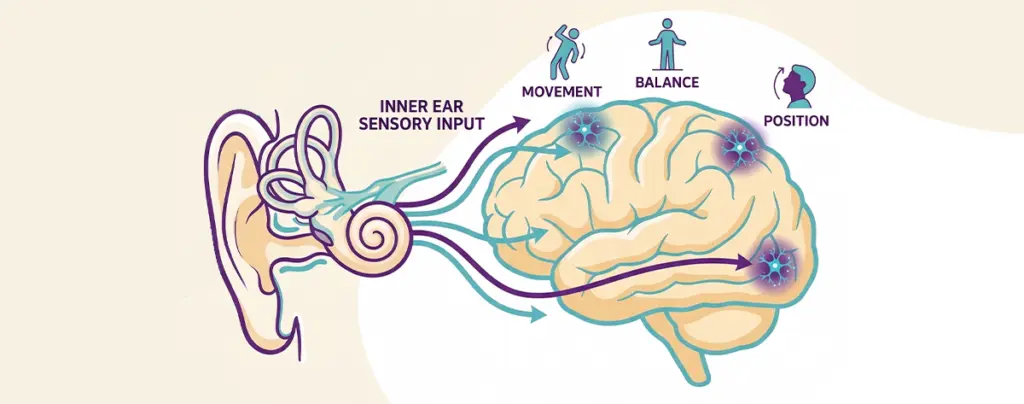
The inner ear contains three balance sensors: semicircular canals, otolith organs, and the vestibular nerve. Each detects a different type of motion, and the brain merges their inputs into a single sense of position.
1. Semicircular Canals (Rotation Sensors)
Semicircular canals detect rotational head movement. Three loop-shaped tubes sit at right angles to each other inside the inner ear, filled with a fluid called endolymph and lined with tiny hair cells.
When you turn your head, the fluid lags behind, bends the hair cells, and triggers an electrical signal. The three orientations let the system pick up rotation in any direction: nodding, shaking, tilting.
2. Otolith Organs (Gravity and Linear Motion Sensors)
Otolith organs detect gravity and linear motion. They consist of two sac-like structures beneath the semicircular canals: the utricle and the saccule. Each contains tiny calcium-carbonate crystals called otoconia, resting on a bed of hair cells.
When you accelerate forward in a car, ride a lift, or tilt your head, gravity pulls the crystals. The hair cells bend, and the brain registers linear motion or a change in head position.
3. The Vestibular Nerve (Signal Carrier)
The vestibular nerve carries balance signals from the inner ear to the brain. Inputs from the semicircular canals and otolith organs feed into the nerve before reaching the brainstem.
From there, the brain coordinates muscle responses, eye movements (the vestibulo-ocular reflex), and conscious awareness of position. Damage to the nerve disrupts the signal even when the sensors themselves are intact.
Signs Your Balance Problems Are Coming from Your Ears
Inner ear balance problems show specific patterns that separate them from other causes of dizziness. Vertigo, ear fullness on one side, and dizziness triggered by head movement are the strongest indicators.
Vertigo is the most specific symptom. It is the false sensation that you or the room is spinning, and it almost always points to a vestibular issue rather than a cardiovascular or neurological one.
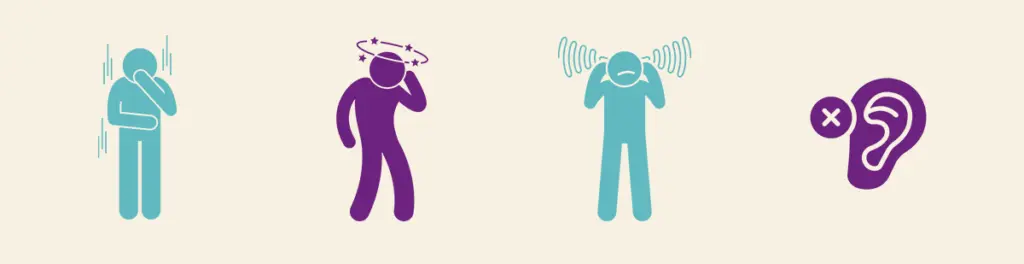
Movement-triggered episodes also point to the inner ear. If rolling over in bed, looking up, or turning quickly brings on dizziness, the cause is likely vestibular.
Other red flags include:
- Difficulty walking in a straight line
- Blurred vision when you turn your head
- Nausea accompanying vertigo
- A feeling of fullness, pressure or muffled hearing in one ear
- Tinnitus or hearing loss appearing around the same time as the balance issue
A combined hearing and balance assessment is the most efficient starting point when these symptoms appear together, since many overlap with the common signs of hearing loss that audiologists already screen for.
5 Common Inner Ear Conditions That Affect Balance
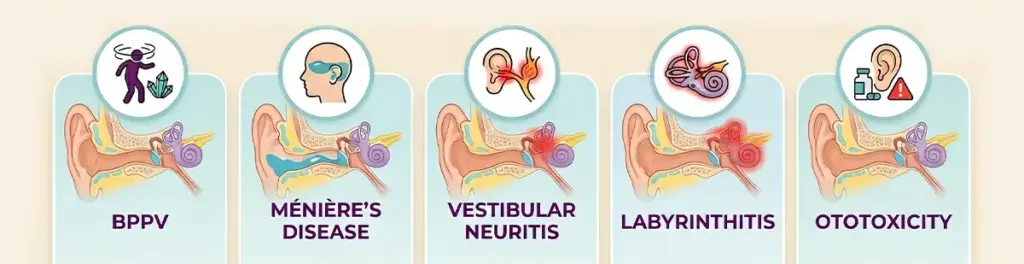
Five conditions account for most inner ear vertigo: BPPV, Ménière’s disease, vestibular neuritis, labyrinthitis and ototoxicity. Each has a distinct symptom pattern, and treatment depends on accurate diagnosis.
1. Benign Paroxysmal Positional Vertigo (BPPV)
BPPV is the most common cause of vertigo overall. It happens when otoconia crystals dislodge from the utricle and float into one of the semicircular canals, where they trigger false motion signals every time the head moves.
Episodes are short (usually under 60 seconds) but intense. BPPV is highly treatable with a repositioning manoeuvre such as the Epley, which moves the crystals back to where they belong.
2. Ménière’s Disease
Ménière’s disease is a chronic inner ear disorder that causes episodes of vertigo lasting 20 minutes to several hours. Episodes are accompanied by fluctuating hearing loss, tinnitus and a feeling of pressure in the affected ear.
The underlying cause is thought to be abnormal fluid buildup in the inner ear. Management combines dietary changes, medication and, in some cases, procedures targeting the inner ear directly. Treatment options for the hearing loss component typically require ongoing audiological review.
3. Vestibular Neuritis
Vestibular neuritis is inflammation of the vestibular nerve, usually triggered by a viral infection. It causes sudden severe vertigo, nausea and imbalance that lasts for days, then gradually resolves over weeks.
Hearing is typically unaffected, which distinguishes it from labyrinthitis. Vestibular rehabilitation therapy accelerates recovery and reduces the risk of long-term imbalance.
4. Labyrinthitis
Labyrinthitis is inflammation of the labyrinth, the bony cavity housing both balance and hearing structures. Symptoms resemble vestibular neuritis but also include hearing loss in the affected ear. Causes include bacterial or viral infection.
Prompt treatment matters. Untreated labyrinthitis can result in permanent sensorineural hearing loss in the affected ear.
5. Ototoxicity
Ototoxicity is hearing or balance damage caused by certain medications. The most common culprits include some antibiotics, chemotherapy agents and high-dose aspirin.
The effect is sometimes reversible if the medication is stopped early. Patients on ototoxic regimens should be monitored audiologically as standard practice. Ototoxicity is one of the more frequently overlooked causes of hearing loss in adults on long-term medication.
Why Hearing Loss and Falls Are Linked in Older Australians
Older adults with hearing loss are around 2.4 times more likely to fall than their normal-hearing peers. A 2023 study in the Journal of the American Geriatrics Society (Campos et al) confirmed this association across a large US cohort, replicating earlier findings from Johns Hopkins research that first linked hearing loss to fall risk.
Three mechanisms explain the connection:
- Shared damage. The same inner ear damage that causes sensorineural hearing loss can affect vestibular hair cells.
- Lost spatial cues. Hearing loss reduces the environmental sound the brain uses for spatial orientation.
- Cognitive load. Straining to hear pulls resources away from the brain’s balance processing.
Falls are the leading cause of injury-related hospitalisation and injury death in Australians aged 65 and over. According to the Australian Institute of Health and Welfare, in 2023-24 older Australians were almost 12 times more likely to be hospitalised due to a fall than working-age adults (25-44).
Untreated hearing loss is a modifiable contributor that often goes unaddressed in falls-prevention programmes. Cognitive decline compounds the risk further, which is why the link between hearing loss and dementia sits alongside falls as a priority intervention area.
Tinnitus, a frequent co-occurring symptom of inner ear damage, also affects balance through cognitive distraction and disrupted spatial cues.
Can Hearing Aids Help Reduce Fall Risk?
Some hearing aids now go beyond hearing and include features built for fall prevention. Freedom Hearing’s own Restore AI range carries them, powered by the Starkey processor and paired with the My Starkey app.
Two tools focus on balance. A balance assessment screens fall risk by tracking balance, gait and strength over time. A Balance Builder then guides a set of exercises designed to strengthen stability.
A third feature works after a fall. Built-in fall detection uses motion sensors in the device to recognise a fall, then sends an automatic alert with the wearer’s location to up to three chosen family members or carers.
These tools support a falls-prevention plan. They do not replace one. The balance assessment is a self-screen, not a clinical vestibular test, and the exercises are not a treatment for conditions such as BPPV or Ménière’s disease.
What to Do If You Feel Unsteady: A 3-Step Action Plan
Persistent balance problems require medical investigation. They signal a problem in the vestibular system, the cardiovascular system, or neurological function, and the earlier the cause is identified, the better the outcome.
- Document the pattern. Note when episodes occur, what triggers them, how long they last, and what other symptoms appear (hearing changes, tinnitus, nausea, visual disturbance). Pattern data is what helps a clinician narrow the cause quickly.
- Book a hearing and balance assessment. A qualified audiologist can identify hearing loss patterns associated with inner ear damage and refer for vestibular function testing where appropriate. A free hearing check is a low-friction starting point. For existing patients, an annual check-up is the right place to raise new balance concerns.
- Reduce fall risk in the meantime. Clear tripping hazards from your home, use bathroom rails, avoid sudden head movements, and never get up too quickly from bed or a chair. These measures buy time while the diagnostic process runs.
Sudden onset symptoms are time-sensitive. If vertigo is severe, accompanied by hearing loss, or follows a head injury, seek medical care the same day. Sudden sensorineural hearing loss responds best to treatment started within the first 72 hours of onset, so early action matters.
Balance is not a single sense. It is the brain’s reconciliation of three streams of information: what your eyes see, what your muscles and joints feel, and what your inner ear measures. When the inner ear input becomes unreliable, the system loses its anchor.
A balance problem that will not resolve is worth investigating audiologically, even when the symptom feels purely neurological or cardiovascular. The ear is one of the most common, and most treatable, sources.
If you have been brushing off dizziness, unsteadiness or fullness in your ears as ageing or stress, it is worth a closer look. Book a free hearing check at your nearest Freedom Hearing clinic to start with the simplest, most accessible piece of the assessment.

This article is for general information only and is not a substitute for professional medical advice. If you are experiencing dizziness, balance problems or sudden hearing changes, speak to your GP, an audiologist or an ear nose and throat (ENT) specialist for diagnosis and personalised guidance.
